
If you've ever read a truly good book review, it has probably made you want to read the book all over again. You've also most likely come across the ones that just repeat the plot and miss the point entirely. So, what is it that separates the forgettable from the insightful? That is the question we'll try to answer here.
This blog brings you 18 real book review examples for students and writers. You’ll also get a breakdown of what actually makes this type of work, so you can apply the same principles in your own writing. And if you need backup along the way, EssayService's reliable platform can help you handle your academic tasks without stress!
Key Components of a Book Review
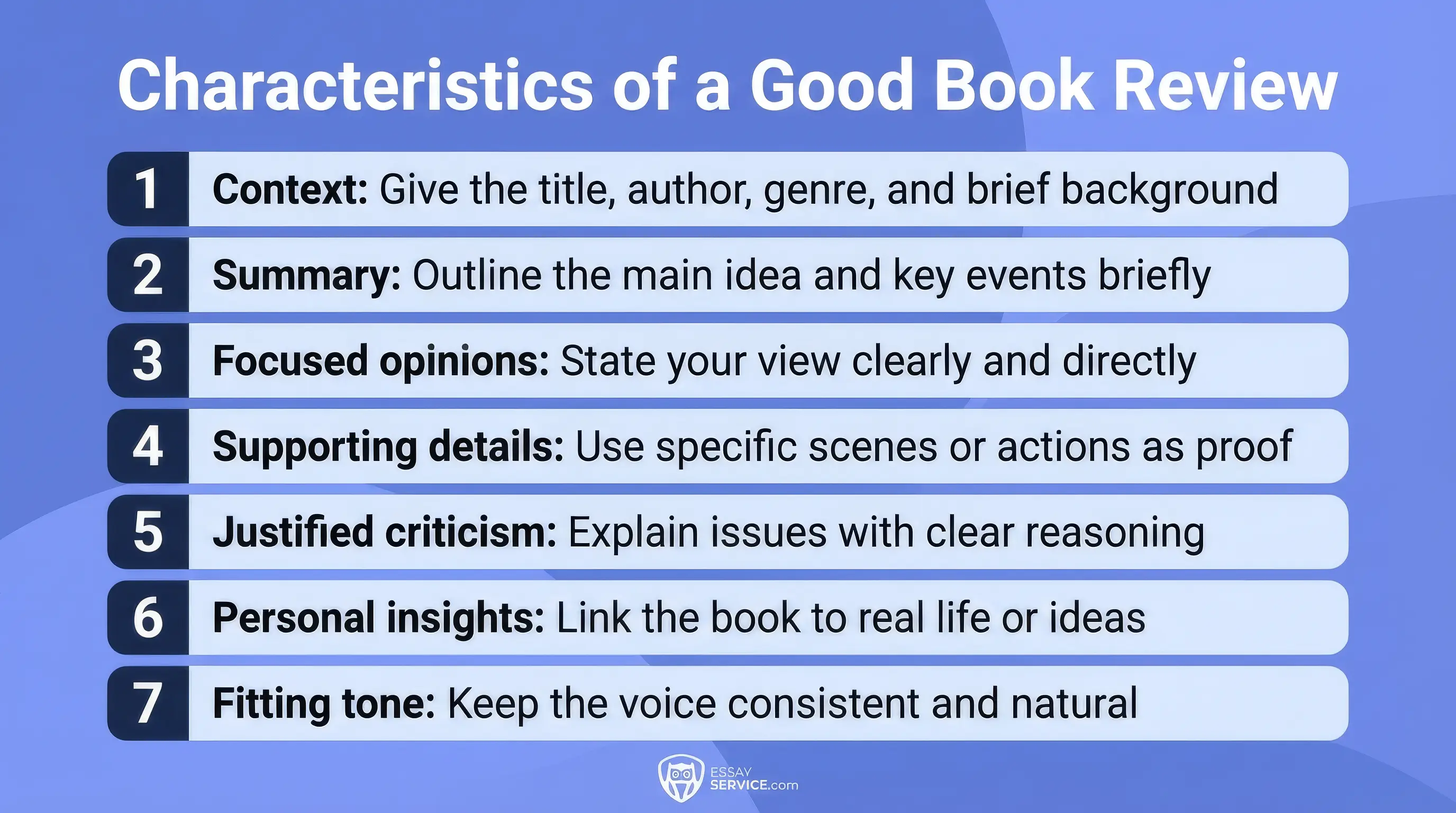
Even if some examples of a book review don't look formal at first read, most of them still have a clear structure and main elements you must include:
- Context: Start by grounding the reader with the book’s title, author, genre, and a brief note on its background so everything that follows makes sense.
- Summary: Provide a concise overview of the story by focusing on the central idea and key events without going through every page.
- Focused opinions: State your views clearly and directly so readers understand your reaction without second-guessing your stance.
- Supporting details: Use specific moments, such as scenes or character actions, to support your points and make your argument credible.
- Justified criticism: When something doesn’t work, explain the issue with clear reasoning instead of vague statements.
- Personal insights: Connect the book to real life or broader ideas to add depth and make the review more engaging.
- Fitting tone: A strong review will maintain a consistent and natural voice so it reads smoothly and feels easy to follow.
If you'd like to take a break while a professional handles your assignments, you can just ask us, 'I need to pay someone to do my homework.'
Pro tip: Read with a pen in hand. Mark exact page numbers where you catch something worth mentioning. This saves time later and gives you concrete evidence instead of vague impressions.


Stop Summarizing. Start Reviewing
Get structured book reviews written by real professionals.
Book Review Examples: Nonfiction
A nonfiction book presents factual information based on real events, research, or personal experience. A review of it should explain the subject, outline the main argument, and assess clarity, accuracy, and depth. It should also comment on the author’s approach, use of evidence, and relevance, while giving a clear, informed opinion for readers.
Raising Hare by Chloe Dalton
Chloe Dalton’s Raising Hare reads like a quiet record of attention. This book review example discusses her experience of caring for a wild hare, and how the story never turns into a neat tale about taming nature. The animal stays itself, unpredictable and distant in small, telling ways.
The book’s strength lies in how Dalton observes. She notices movement, silence, and small changes in behavior. These moments build the story forward without forcing drama. A simple scene, such as the hare pausing at the edge of a field, carries more weight than a staged turning point would.
Her writing style leans toward restraint. The language stays controlled and precise, which fits the subject. At times, the pace slows enough that some readers may feel the narrative holds back. Still, that choice reflects the reality she presents. Nothing about this experience moves quickly.
Dalton also reflects on her own role with care. She avoids turning the situation into a story about control or rescue. Instead, she pays attention to boundaries. The relationship remains uneven, shaped by instinct on one side and observation on the other.
The book does not offer a traditional arc. It grows through repetition and variation, much like the routines it describes. That approach may challenge readers who expect clear milestones.
In the end, Raising Hare stays focused on presence. It asks for patience and gives a detailed, grounded account of contact between human life and the natural world.
My Next Breath by Jeremy Renner
Jeremy Renner doesn’t treat My Next Breath like a polished memoir. It reads closer to a log of survival, written by someone who kept waking up and couldn’t quite believe it kept happening.
The accident sits at the center, but the book keeps circling the smaller aftermath instead. He spends pages on things most people ignore: how long it takes to sit up, how breathing changes when ribs no longer feel stable, how a body can feel both present and unreliable at the same time. The focus stays narrow, almost stubbornly so.
There’s a certain bluntness to the way he writes. He doesn’t try to shape every moment into meaning. Some sections feel unfinished, as if the thought stopped where the experience stopped. That rough edge works in his favor. It gives the book a sense of immediacy.
At points, the narrative drifts into memory. Fragments of earlier life appear without much setup. They don’t build a full picture, yet they hint at what’s at stake. The contrast between then and now sits quietly in the background.
The emotional weight doesn’t come from dramatic statements. It shows up in repetition. Trying again. Failing. Trying again. That rhythm carries the book forward more than any clear turning point.
My Next Breath doesn’t aim for inspiration in a traditional sense. It stays close to the physical and the immediate, documenting what it means to keep going when each next breath has to be earned.
Pro tip : Right after finishing the book, write a short 3–4 sentence reaction without checking anything. This helps you keep your honest first impression before you start editing.
Book Review Writing Examples: Fiction
A fiction book builds its story out of imagination, shaping characters, events, and settings that don’t claim to be real. Examples of book reviews in this genre should briefly explain the book’s plot without giving away key twists, then examine how the characters work, what themes emerge, and how the writing style reads. Good book reviews should also assess pacing, highlight strengths and weaknesses, and offer a clear opinion that helps readers decide whether it’s worth their time.
My Friends by Fredrik Backman
Some novels try to impress you with scale. My Friends moves in the opposite direction. Fredrik Backman keeps the lens close, almost uncomfortably so, and lets small interactions carry the weight.
At first glance, the story looks simple. A group of people tied together by shared history, drifting in and out of each other’s lives. But Backman doesn’t rush to explain what holds them together. He lets conversations do that work. A joke that lands awkwardly. A silence that lasts a second too long. Those moments stack up until the connections feel real.
This book review sample could easily focus on the plot, but that would miss the point. The novel lives inside its characters. They feel unfinished in a way that makes sense. People change, but not all at once, and not in clean directions. Backman leans into that messiness.
The structure might catch some readers off guard. The narrative moves between past and present without warning. That shifting timeline builds understanding slowly, piece by piece. It asks for attention, but it pays it back.
There’s humor here, though it stays close to discomfort. Backman has a way of making you laugh and then question why you did. That tension runs through the entire book.
My Friends doesn’t try to deliver a single message. It circles around connection, memory, and the quiet ways people stay in each other’s lives.
Wild Dark Shore by Charlotte McConaghy
You don’t move through Wild Dark Shore with any sense of certainty. The ground keeps shifting, even when nothing obvious happens, and that feeling settles in early.
Charlotte McConaghy places the story on a remote coastline where isolation shapes every decision. The setting does more than frame events. It presses on the characters, limits their options, and exposes what they carry with them. The sea, the wind, the distance from any stable point, and all of it matter.
The narrative unfolds through fragments. Information comes in pieces, often delayed, sometimes withheld. That structure asks for attention. You begin to assemble the past alongside the present, and the full picture never arrives all at once.
This book review sample could track the book’s plot, but the real experience lies in what the novel chooses not to explain immediately. McConaghy allows uncertainty to stay in place longer than expected, and that choice creates tension that doesn’t rely on action alone.
The characters don’t present themselves fully. Their histories surface through small disclosures, each one shifting how you read what came before. That approach builds emotional weight without forcing dramatic turns.
The prose remains measured, even when the situation grows more severe. That control sharpens the impact of every reveal.
Wild Dark Shore stays with its atmosphere and lets it do the work, building a story that unfolds through pressure, memory, and the slow exposure of truth.
Pro tip: Pull 2 exact scenes and 1 specific line from the book. Build your review around those. If you can’t point to concrete moments, your review will sound generic.
Examples of a Book Review: Thrillers
In thrillers, those tense and uncertain moments can change everything. Writing a review for a thriller book asks you to trace the way suspense builds and how the story keeps you turning pages. Take a look at three thriller book review samples that focus on what makes each story land.
Not Quite Dead Yet by Holly Jackson
Pip is back, but Not Quite Dead Yet doesn’t rely on familiarity to carry it. Holly Jackson pushes the character into a tighter, more controlled mystery where every clue feels placed with intention.
The story opens with a case that looks manageable on the surface, then quickly folds in on itself. Information shifts. Motives blur. Each answer leads somewhere slightly off, which keeps the investigation moving without feeling repetitive. The pacing stays sharp, and chapters end at points that make it hard to pause.
This review leans into how the structure works. Jackson builds tension through sequencing rather than spectacle. Scenes follow each other with precision, and small details gain importance as the story develops. That approach rewards close reading.
Pip’s perspective drives everything. Her thinking shapes the rhythm of the book, especially when she starts questioning her own assumptions. That internal pressure adds another layer to the mystery. It’s not just about solving the case. It’s about deciding what to trust.
The supporting cast plays a clear role in that process. Friends, suspects, and witnesses all bring different pieces, and their interactions with Pip create steady friction. Dialogue carries much of that weight, often revealing more than it seems at first.
Jackson’s writing stays clean and controlled, which fits the genre. The focus remains on clarity and momentum.
Not Quite Dead Yet delivers a tightly built mystery that keeps its attention on process, choice, and the consequences that follow each decision.
The Tenant by Freida McFadden
You settle into The Tenant expecting a simple arrangement: a room, a landlord, a set of rules. Frieda McFadden treats that setup like a locked door and starts turning the handle slowly.
The tension grows through routine. Small interactions carry weight. A glance that lingers too long, a question that feels slightly misplaced, a detail that doesn’t quite fit. The story builds its momentum through these moments, and they stack until the situation feels unstable.
The narrative stays close to the main character, and that perspective shapes everything. Each event is filtered through personal interpretation, which adds uncertainty. You begin to question what is seen, what is assumed, and what might be hidden just out of reach.
McFadden structures the plot around gradual revelation. Information appears in controlled portions, and each new detail shifts the direction of the story. The pacing holds steady for most of the book, then tightens as the stakes rise. That progression keeps the reading experience engaging without relying on constant shock.
Dialogue plays a key role. Conversations carry hints that become clearer later, and certain exchanges take on new meaning as the story unfolds. Secondary characters contribute to that effect, each adding a layer of tension.
The final section moves quickly. Earlier details connect, and the story reaches a sharp conclusion.
The Tenant focuses on control, perception, and how ordinary situations can shift into something far more unsettling.
Good Book Review Examples: Science Fiction
A science fiction book review should cover world-building, including how the imagined setting operates and feels consistent. It should evaluate the central ideas, such as technology or future scenarios, and how they affect the story. The review should also assess characters, plot coherence, and whether the concepts feel believable within the book’s own logic.
The Compound by Aisling Rawle
The first thing that stands out in The Compound is how quickly the rules begin to matter. They aren’t explained in long passages. They show up through behavior. Who speaks, who stays quiet, who follows, who hesitates. You start learning the system the same way the characters live inside it: by watching.
Aisling Rawle keeps the setting tight and contained, but the tension spreads through small shifts rather than large events. A change in routine carries weight. A minor decision lingers longer than expected. The atmosphere builds through repetition that slowly stops feeling normal.
Time plays a strange role here. Days seem structured, yet the sense of progression feels uneven. Some moments stretch, others pass without clear markers. That imbalance adds to the unease. You’re never fully sure how long anything has been happening, and that uncertainty feeds into the story.
What makes the book work is how little is stated outright. Motivations surface in fragments. A line of dialogue, a reaction, a refusal to answer. You begin to piece together intentions without ever receiving a full explanation.
The characters exist in relation to the space around them. Their choices reflect the limits placed on them, but also the ways they try to push against those limits.
By the end, the structure itself becomes part of the story. It shapes behavior, distorts perception, and leaves a lasting impression that extends beyond the final page.
The Book of Lost Hours by Hayley Gelfuso
A clock appears early in The Book of Lost Hours, and it refuses to behave. Time slips, stalls, folds back on itself, and Hayley Gelfuso builds the entire novel around that instability. The story follows a librarian who begins to notice missing hours, not in theory, but in lived experience. Conversations restart. Objects shift places. Memory stops matching the present.
The narrative moves in loops. Scenes return with slight changes, which force attention on details that would usually pass unnoticed. A line spoken twice carries a different weight the second time. A familiar place feels altered. That structure creates tension through recognition rather than surprise.
This example of a book review centers on how the book treats time as something personal. It affects relationships first. Friends question each other. Trust becomes fragile when shared moments no longer align. The emotional core grows out of that confusion.
Gelfuso writes with precision. Each scene holds a purpose, even when the meaning isn’t immediately clear. The pacing allows space for reflection, which suits the concept.
The characters respond in distinct ways. Some try to document everything. Others choose to ignore what they can’t explain. Those reactions shape the direction of the story.
By the final chapters, the pattern of lost hours forms a clearer design. The novel closes with a sense of resolution that feels earned through careful buildup, leaving a lasting impression about memory and perception.
Book Review Examples: Romance
A romance book review should cover the relationship at the center of the story, including how it develops and feels believable. It should discuss character chemistry, emotional depth, and key turning points. The review should also evaluate pacing, dialogue, and whether the ending feels satisfying within the story’s emotional arc.
Great Big Beautiful Life by Emily Henry
A missed call opens Great Big Beautiful Life, and that small interruption ends up shaping everything that follows. Emily Henry builds the story around timing: calls answered too late, messages sent at the wrong moment, conversations that circle instead of landing.
The novel follows two people whose lives intersect through a series of almost-coincidences that don’t feel accidental once you sit with them. Each encounter carries a sense that something could shift, yet the shift never arrives all at once. It accumulates.
Henry gives attention to ordinary moments. Shared meals, long walks, unfinished conversations. These scenes stretch just enough to reveal what each character avoids saying directly. The tension grows out of hesitation rather than conflict.
This sample of book review looks at how the relationship develops through timing instead of dramatic events. The connection builds through repetition, through returning to the same spaces with slightly different awareness each time. That pattern creates a steady emotional pull.
The dialogue moves quickly, with humor woven into nearly every exchange. It keeps the tone grounded and keeps the story moving. Beneath that surface, both characters carry unresolved parts of their past that shape how they respond to each other.
The structure follows their separate lives as much as their shared moments. Work, friendships, and personal goals remain present, which gives the relationship context.
By the end, the story lands on a sense of clarity that feels earned through accumulation rather than a single turning point, leaving a lasting impression about timing and connection.
Pro tip: Limit your summary to 2 sentences. Use the rest of the review to share your thoughts and explain your opinion.
Say You'll Remember Me by Abby Jimenez
A note shows up before the relationship even has time to settle. It sits there, quiet but impossible to ignore, and Say You’ll Remember Me grows around that single promise.
Abby Jimenez builds the story through memory rather than momentum. Moments don’t fade. They linger, replay, and take on new meaning as the characters try to move forward. A conversation from early on returns later with a different weight. A decision that once felt small starts to shape everything that follows.
The connection between the two leads develops in fragments. Time passes, circumstances shift, and what they share never feels fully contained within one stage of life. Their interactions carry warmth, but also a kind of restraint, as if both understand the cost of getting it wrong.
Jimenez places everyday details at the center. Work, family obligations, and personal struggles stay present throughout the story. Those elements don’t sit in the background. They actively influence what the characters choose to do and what they avoid.
Emotion builds through repetition. A phrase repeated. A place revisited. A memory that refuses to settle. That rhythm gives the story its shape.
The pacing allows space for reflection, which makes each step forward feel considered rather than rushed. When clarity finally arrives, it comes through recognition rather than revelation.
Say You’ll Remember Me focuses on how people carry each other through time, even when their lives don’t move in the same direction, and how certain connections continue to shape what comes next.
Book Review Examples: Young Adult
A young adult book review should focus on characters, especially how relatable they feel to teen readers. It should explain the central conflict, pacing, and emotional stakes, since these drive engagement in this genre. Strong short book review examples in YA genre also evaluate themes like identity, friendship, or growth, along with writing style and overall readability.
Fake Skating by Lynn Painter
The rink never really sits still in Fake Skating. Even when no one is on the ice, there’s a sense of motion that carries into every scene. Lynn Painter builds the story around that energy, using it to shape both the setting and the relationship at the center.
The premise leans on a familiar setup, two people pretending for practical reasons, yet the execution feels grounded in timing and reaction. Each practice, each conversation, adds another layer. What starts as performance gradually turns into something harder to define.
Painter gives attention to how routines shape connection. Early mornings, repeated drills, shared spaces that become familiar through use. These moments don’t just fill the background. They create a rhythm that brings the characters closer, step by step.
Dialogue moves quickly and carries much of the story. Jokes land, then circle back later with a different tone. Lines that seem casual at first gain weight as the situation develops. That progression keeps the emotional thread active.
The characters respond to pressure in distinct ways. One leans into control, the other into deflection, and that contrast drives their interactions forward without forcing conflict.
Scenes often return to the ice, where movement replaces explanation. A shift in pace, a missed step, a moment of balance regained... each detail reflects what’s happening beneath the surface.
By the final chapters, the story settles into clarity through accumulation. What began as a simple arrangement evolves into something shaped by time, shared effort, and the slow recognition of what has been building all along.
Glorious Rivals by Jennifer Lynn Barnes
Competition arrives first in Glorious Rivals. It sets the pace before the characters even settle into place, and Jennifer Lynn Barnes keeps that tension active through every chapter. The story unfolds around a high-stakes environment where every move is watched, measured, and remembered.
The main characters treat each interaction like a calculation. Conversations carry strategy. A simple exchange can shift alliances or reveal intentions. That approach gives the story a sharp edge and keeps attention on how decisions are made rather than what is said outright.
This short book review example focuses on how the book builds momentum through rivalry. The central relationship evolves through challenge, not comfort. Each character pushes the other, and that pressure creates movement in the plot.
Barnes structures the narrative with precision. Clues appear in small pieces, and each one gains importance as the story progresses. The pacing stays controlled, with moments of intensity placed carefully to maintain engagement.
The setting reinforces the competitive atmosphere. Rules, expectations, and hidden motives shape the environment and influence every action. Nothing feels random, which strengthens the sense of direction.
Character dynamics extend beyond the central pair. Secondary figures add complexity, each bringing their own goals into the mix. Their presence keeps the stakes active.
By the final chapters, the rivalry reaches a clear resolution shaped by strategy, timing, and the consequences of earlier choices.
Skip the Stress
Get a finished, original book review that meets all of your requirements.
The Final Chapter
For a successful book review, you have to notice the author's tone and think about the choices they made to move the story forward. Here's what to remember before you jump into writing your next review:
- Any great book review needs a clear structure: intro, analysis, critique, and conclusion
- Focus on how the book made you think or feel, not just what happened in it
- Avoid plot summaries. Share insights, not spoilers
- Keep your tone honest and specific
- Let the author’s work guide your response, but don’t be afraid to bring your own voice
If you have to write a book review for your English class and have no idea how to approach it, EssayService can help at any time. Our reliable essay writing platform gives students professional academic guidance for all kinds of assignments.
FAQs
Frequently Asked Questions
What Does a Book Review Look Like?
How to Write a Review on a Book with Examples?
What Is an Example of a Book Review?
Where Can I Find Popular Book Review Examples?
How Can I Use Book Review Examples for Writing My Own One?

Anna has been helping students become more productive learners for 20+ years now. Her experience, combined with a Master’s degree in psychology, ensures her blog posts contain only valuable insights.
- Announcing the Goodreads Choice Winner in Readers’ Favorite Fiction! (2025). Goodreads https://www.goodreads.com/choiceawards/readers-favorite-fiction-books-2025
- Announcing the Goodreads Choice Winner in Readers’ Favorite Mystery & Thriller! (2025). Goodreads. https://www.goodreads.com/choiceawards/readers-favorite-mystery-thriller-books-2025
- Announcing the Goodreads Choice Winner in Readers’ Favorite Science Fiction! (2025). Goodreads. https://www.goodreads.com/choiceawards/readers-favorite-science-fiction-books-2025
- Announcing the Goodreads Choice Winner in Readers’ Favorite Romance! (2025). Goodreads. https://www.goodreads.com/choiceawards/readers-favorite-romance-books-2025
- Announcing the Goodreads Choice Winner in Readers’ Favorite Young Adult Fiction! (2025). Goodreads. https://www.goodreads.com/choiceawards/readers-favorite-ya-fiction-books-2025
.webp)
.png)

New posts to your inbox
Your submission has been received!